Showing posts with label Lychgate. Show all posts

Sunday, 11 September 2016

INQ28 - Oldhammer style!

Sometimes, when you're searching through your lead bits box (that one that has been around for about two decades now), you find those little diamonds that you completely forgot about and aren't entirely certain when it was you acquired them.

Anyway, some of you may have noticed that I've been building the world of Glebe IV with a view for something playable in the future, so when I found this little diamond, things instantly clicked around a new (more militant) warband.

Photo courtesy of Solegends

So, I discovered that this little diamond is a rather old Aly Morrison sculpt from the Citadel Miniatures AD&D range. Obviously she has a very 'classic witch hunter' look to her, so she is destined for the Ordo Hereticus. I planned to change her 'stop in the name of love' right hand/arm so that she is hold a pistol of some sort (to properly tie her into the 41st Millennium). The only unfortunate thing is that she is at 25mm rather than 28mm, meaning she is a tad on the small side, so I will probably put her on a base elevated with some kind of scenery. Actually, her petite-ness puts me in mind of John Blanche's very own Hilgardius.

Photo courtesy of Iron Sleet

Now I must figure out what sort of weapon to give my female Solomon Kane!

Спасибо за прочтение


Saturday, 10 September 2016

Frankylmoign

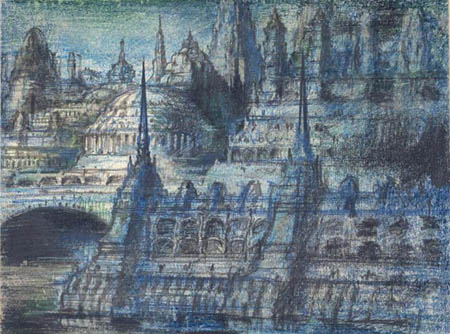
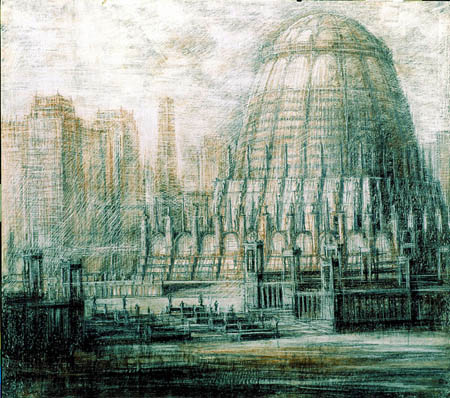
Lately, a friend of mine suggested that I check out the conceptual artwork of the lesser known Soviet constructivist architect Yakov Chernikhov. They are simply majestic to view and it is thrilling to think how the many cities of Russia would look today if even half of these were built.

Of course, they are perfectly suited to the aesthetics of the Imperium in the 41st Millennium and I imagine that Frankylmoign is thoroughly bedecked with buildings such as these. Enjoy.


Спасибо за прочтение


Monday, 5 September 2016

The Lychgate

Despite the, what I hope to be evocative, locations in Undercroft City and Reliquary that make up the city of Frankylmoign that I've laid out earlier, it is the Lychgate that I hope to be the centre stage of this particular setting and, unlike the two mentioned previously that could have long term campaigns set in them, would be a one time event.

Traditionally, lychgates tend to be the small archway entrances into the churchyard, but of course, for this major landmark on Glebe IV, it would have to be much bigger, more grandiose and, of course, baroquely gothic. I instead looked at triumphal arches for inspiration as they also have a connection with the dead (normally as grand tombstones marking a special grave site) and found a very detailed drawing of the Arch of Maximillian I by Albrecht Durer that is simply spectacular and very fitting for the 41st Millennium.

If you hear a citizen of Frankylmoign talk about lychgates, they are almost always referring to The Lychgate, the grand archway with stands sentry as the gates to the mausoleum of Glebe IV's patron saint; Saint Zabojca. Erected sometime in the closing years of the 31st Millennium following the devastating fires of the Great Heresy, where Saint Zabojca sacrificed her life in defence of Glebe IV against the daemonic horrors that invaded the world. But of course, many variations of her heroic tale are told elsewhere..... 


Спасибо за прочтение

Sunday, 4 September 2016

The Reliquary

The idea for the Reliquary came about as I was discussing the newly released version of Kill Team with a local hobbyist. I had recently finished reading the latest novel in the Invisible Library series by Genevieve Cogman (a little disjointed and sometimes frustratingly under-fleshed series, but well worth the read) and moving from discussing the typically gothic-industrial/underhive setting that would work really well for Kill Team (seeing as it is something of a simplified Necromunda) I proposed the idea of a continent-sized baroque library would be fun too. Indeed, I could easily imagine a protracted firefight between the likes of PDH's Ordo Scriptorum and the Reliquary archivist guards.

As for tangible imagery concerning the Reliquary, I immediately turned to graphic representations of Lord Sepulchrave's library in the Gormenghast series and Vincent Ward's concept art for the Monastery (to be used in the original Alien 3).

Almost every Shrine World has some kind of centralised reliquary, where the sacred artefacts of the subsector (and sometimes the entire sector) are housed, alongside varying copies and editions of religious texts (some rare, some not). The Reliquary on Glebe IV is the largest in the galactic cluster, easily spanning several million kilometres. It is a continent-sized edifice of crenelated spires, curved domes, gargantuan arches and intricate stained glass windows that stand miles tall.

They say that many pilgrims that enter its monolithic walls, can spend their entire lives looking for that one relic hidden amongst the twisting labyrinths of packed shelves. They say that some internecine skirmishes over the ownership of certain holy artefacts ground to a stalemate several centuries ago, with the newer generations born since unwilling to break the attrition.


Спасибо за прочтение

Friday, 2 September 2016

Undercroft City

A while ago, I remember reading the blog of a rather splendid author who was writing about the Carceri d'invenzione prints of Giovanni Battista Piranesi, which heavily influenced the Romanticism and Surrealism of later ages, and inspired later surrealists like Kafka and Escher. More closer to home, it is easy to just how much of the Mordheim artwork was perhaps inspired by these prints too. Indeed, the Carceri prints are exactly how I imagined Undercroft City:

Undercroft City is the very mirror of Frankylmoign, as above so below, the City itself is a twisting maze of consecrated waterways, sewers, crypts, hidden shrines, sunken cathedrals and catacombs. It is a known haven for the more darker and unsavoury cults ratified by the Ministorum; followers of flesh, blood and pain stalk its gloomy walkways, outlawed redemptionists organise their crusades and black priests offer vices beyond imagination to enable anyone to sin in the Emperor's name. The theohooligans and recusant-gangs mark out their territories with arcane symbols, grimly coloured candles and incense-markers.


Спасибо за прочтение