Showing posts with label 40K Art. Show all posts

Tuesday, 7 November 2017

The Iron Sleet Invitational - Take Two

Well, I managed to get four of my squaddies ready for the Iron Sleet Invitational, but I was delayed with the officer for lack of a torso. Anyway, I was kindly given a week to finish him and retake the photos for the Sleeters big reveal. Despite a couple of modelling dead-ends and a minor design shuffle, I got him finished in record time (well, a personal best anyway).


I decided that a mounted officer was the way to go, so I packed his horse with the same distribution of equipment seen on the cavalrymen in WW1. The steed is also wearing a style of gasmask seen in the latter months of the war (which covered the muzzle, but didn't include glass lenses for the eyes). I've already talked about the differences in swords between officers and NCOs, so whilst my sergeant has one forged in their thousands on an assembly line, my lieutenant one bespoke, crafted by artificers (although it is his father's sword - my lieutenant is young, given his commission by virtue of his family's social standing; the Thorn Moons is his first field of battle).  

I remounted my boys on a 1912 copy of the Kings Regulations that I found in the depths of my library for added flavour.


Спасибо за прочтение

Tuesday, 31 October 2017

The Iron Sleet Invitational

It's about time I wrote something about it seeing as I've been beavering away at my guardsmen for a goodly fortnight. The Sleeter's terms were simple; to explore the nightmarish future of the 41st Millennium through the eyes of the humble guardsman. It certainly is an interesting proposal and one that I've seen interpreted a number of different ways by other modellers. Some have chosen to focus on a cohesive look for their regiment, whilst others have gone for a riotous band of individuals.

I'd like to think that I've gone for the middle ground with my interpretation; a cohesive look for my regiment and adding a smattering of individual touches. Another thing I noticed when I first started was that the feudalism aesthetic was flavour of the month, so I had to rethink my approach. In the end I went in a direction I'd gone before; the WW1 aesthetic.


For me, the first World War is perhaps the closest real life event we have that mirrors what war is like in the 41st Millennium; they had vast advances in technology but their military tactics hadn't really advanced much since the Napoleonic era. I've also read it described as the most brutal war mankind has ever fought, not to mention the accounts of the veterans who described trench warfare on the frontlines to be the closest thing to a genuine hell on earth.

I did not seek to glorify the nature of that war in my aesthetic, nor caricature the very real nightmare those veterans suffered in those four hellish years, but rather hope to present these two theme in a very visceral way. However, it has occurred to me only now that the deadline is upon us, that Remembrance Sunday is just around the corner.

So it is that the Albion IV 'Iron' Corps, 27th (Mercia) Division, 94th Brigade, 2nd Infantry Battalion, Y Company march to war in the Thorn Moons. As one of the first field armies of the Imperial Crusade into the Crataegus Fragmentum, they were also one of the first to make planetfall into the meatgrinder. These five represent perhaps the last of the Albion IV, cut off from their own, they can only hope to regroup with a friendly force before they're all lost.....


They went with songs to the battle, they were young.
Straight of limb, true of eye, steady and aglow.
They were staunch to the end against odds uncounted,
They fell with their faces to the foe.

They shall grow not old, as we that are left grow old:
Age shall not weary them, nor the years condemn.
At the going down of the sun and in the morning,
We will remember them.

They mingle not with their laughing comrades again;
They sit no more at familiar tables of home;
They have no lot in our labours of the day-time;
They sleep beside the Emperor's Throne.
 

Спасибо за прочтение

Sunday, 22 January 2017

Green Fingers and Chainaxes

Carrying on from The Green Death post earlier, I've been beavering away at this little warband for about a week, determined to create a small host of characters that were simple to build with only a little greenstuff intervention.

Black and white photos seem to be en vogue right now


Most of these characters (with the exception of Quayle) have gone through a number of rethinks on particular parts, but I'm rather pleased with how they've turned out (especially the Argyraspides).


Inquisitor Dimmock (name pending) still needs a little work, adding extra trinkets, tokens, gewgaws and fetishes, so I will be rooting through my bits box before painting her.

 The Argyraspides

As I've said, I'm rather pleased with how he eventually turned out, using an old plastic Goliath that I was donated by a friend.

Quayle

Quayle was actually made for a different project idea I had several months ago, but was discarded. I'm really looking forward to trying out some new painting techniques on him, more specifically, painting his blades to look like pink/yellow coral.

Holy Arborists of the Orders Botanicae

I was drawn to the idea of including a couple of bizarre lumberjack-warrior monks. Indeed there is a rather nice quote in which the term 'lumberjack' is first used:

"my misfortunes have been brought upon me chiefly by an incorrigible, though perhaps useful, race of mortals called LUMBERJACKS, whom, however, I would name the Cossack's of Upper Canada, who, having been reared among the oaks and pines of the wild forest, have never been subjected to the salutary restraint of laws."

Anyway, looking forward to getting these guys painted and maybe even get a game in (if I'm lucky)!


Спасибо за прочтение

Tuesday, 29 November 2016

Random sketches

Trying out sketching things; thought I'd start with the reclusive, rattie obsessed Inquisitrix idea I've been playing with, who I envisaged kind of like Madame Web.


Спасибо за прочтение


Saturday, 10 September 2016

Frankylmoign

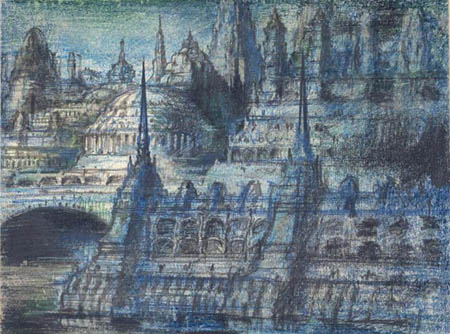
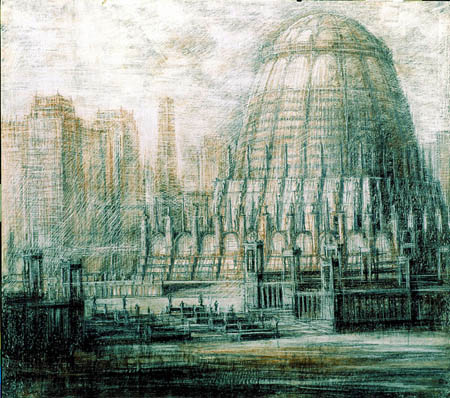
Lately, a friend of mine suggested that I check out the conceptual artwork of the lesser known Soviet constructivist architect Yakov Chernikhov. They are simply majestic to view and it is thrilling to think how the many cities of Russia would look today if even half of these were built.

Of course, they are perfectly suited to the aesthetics of the Imperium in the 41st Millennium and I imagine that Frankylmoign is thoroughly bedecked with buildings such as these. Enjoy.


Спасибо за прочтение


Monday, 5 September 2016

The Lychgate

Despite the, what I hope to be evocative, locations in Undercroft City and Reliquary that make up the city of Frankylmoign that I've laid out earlier, it is the Lychgate that I hope to be the centre stage of this particular setting and, unlike the two mentioned previously that could have long term campaigns set in them, would be a one time event.

Traditionally, lychgates tend to be the small archway entrances into the churchyard, but of course, for this major landmark on Glebe IV, it would have to be much bigger, more grandiose and, of course, baroquely gothic. I instead looked at triumphal arches for inspiration as they also have a connection with the dead (normally as grand tombstones marking a special grave site) and found a very detailed drawing of the Arch of Maximillian I by Albrecht Durer that is simply spectacular and very fitting for the 41st Millennium.

If you hear a citizen of Frankylmoign talk about lychgates, they are almost always referring to The Lychgate, the grand archway with stands sentry as the gates to the mausoleum of Glebe IV's patron saint; Saint Zabojca. Erected sometime in the closing years of the 31st Millennium following the devastating fires of the Great Heresy, where Saint Zabojca sacrificed her life in defence of Glebe IV against the daemonic horrors that invaded the world. But of course, many variations of her heroic tale are told elsewhere..... 


Спасибо за прочтение

Sunday, 4 September 2016

The Reliquary

The idea for the Reliquary came about as I was discussing the newly released version of Kill Team with a local hobbyist. I had recently finished reading the latest novel in the Invisible Library series by Genevieve Cogman (a little disjointed and sometimes frustratingly under-fleshed series, but well worth the read) and moving from discussing the typically gothic-industrial/underhive setting that would work really well for Kill Team (seeing as it is something of a simplified Necromunda) I proposed the idea of a continent-sized baroque library would be fun too. Indeed, I could easily imagine a protracted firefight between the likes of PDH's Ordo Scriptorum and the Reliquary archivist guards.

As for tangible imagery concerning the Reliquary, I immediately turned to graphic representations of Lord Sepulchrave's library in the Gormenghast series and Vincent Ward's concept art for the Monastery (to be used in the original Alien 3).

Almost every Shrine World has some kind of centralised reliquary, where the sacred artefacts of the subsector (and sometimes the entire sector) are housed, alongside varying copies and editions of religious texts (some rare, some not). The Reliquary on Glebe IV is the largest in the galactic cluster, easily spanning several million kilometres. It is a continent-sized edifice of crenelated spires, curved domes, gargantuan arches and intricate stained glass windows that stand miles tall.

They say that many pilgrims that enter its monolithic walls, can spend their entire lives looking for that one relic hidden amongst the twisting labyrinths of packed shelves. They say that some internecine skirmishes over the ownership of certain holy artefacts ground to a stalemate several centuries ago, with the newer generations born since unwilling to break the attrition.


Спасибо за прочтение

Friday, 2 September 2016

Undercroft City

A while ago, I remember reading the blog of a rather splendid author who was writing about the Carceri d'invenzione prints of Giovanni Battista Piranesi, which heavily influenced the Romanticism and Surrealism of later ages, and inspired later surrealists like Kafka and Escher. More closer to home, it is easy to just how much of the Mordheim artwork was perhaps inspired by these prints too. Indeed, the Carceri prints are exactly how I imagined Undercroft City:

Undercroft City is the very mirror of Frankylmoign, as above so below, the City itself is a twisting maze of consecrated waterways, sewers, crypts, hidden shrines, sunken cathedrals and catacombs. It is a known haven for the more darker and unsavoury cults ratified by the Ministorum; followers of flesh, blood and pain stalk its gloomy walkways, outlawed redemptionists organise their crusades and black priests offer vices beyond imagination to enable anyone to sin in the Emperor's name. The theohooligans and recusant-gangs mark out their territories with arcane symbols, grimly coloured candles and incense-markers.


Спасибо за прочтение